Company profile
SBF Visa Group is one of the most recognizable Italian suppliers of compact family attractions. The company is based in the province of Padua and presents itself as a group in which SBF srl and Visa International srl combine design, production, sales and service. Its official history reaches back to 1952, when Italo Frison opened a small workshop in Casale di Scodosia and began building miniature cars and early children's rides from sheet metal, hand tools and persistence. That artisanal origin remains visible in the mix of simple mechanics, sturdy steel fabrication and colorful forms that characterizes many SBF Visa rides.
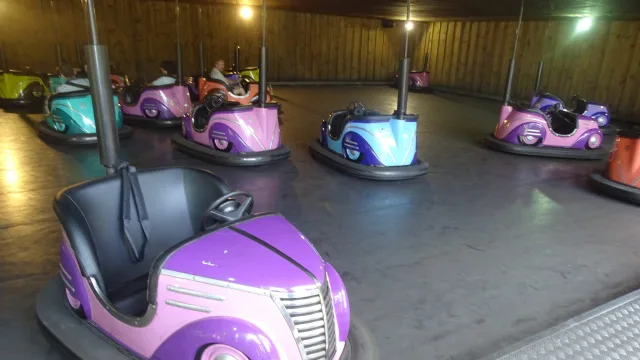
The modern group serves fixed amusement parks as well as travelling showmen, shopping centers, indoor parks and leisure operators. Its catalogue is broad: children's coasters, spinning coasters, family coaster models, track rides, towers, mini jets, carousels, convoy rides, drop towers, compact thrill rides and themed pavilions. SBF Visa has become especially known for attractions with a modest footprint and relatively straightforward operation. For parks that want to reinforce a children's zone or family route quickly, the standard models offer a familiar balance of capacity, construction simplicity and customizable decoration.
The company emphasizes that it operates several production plants between Padua and Rovigo. Within that structure, design, woodworking and steel fabrication, fiberglass components, electrical systems, assembly and testing are combined. This lets the manufacturer deliver many variations without treating every installation as a completely new engineering project. Official company information refers to more than 150 employees, a similar number of external collaborators and annual output of about 250 rides. That scale does not make SBF Visa a builder of the industry's largest record machines, but it does make it a steady supplier of the attractions that form the everyday backbone of many family parks.
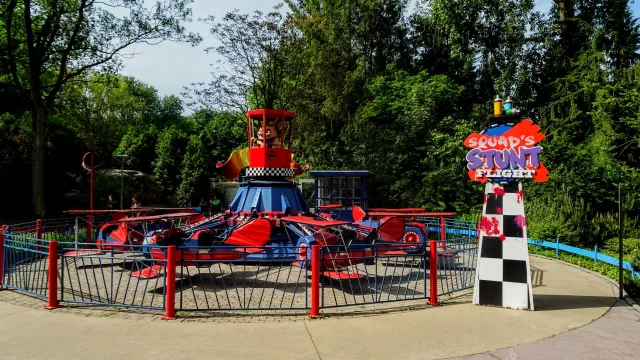
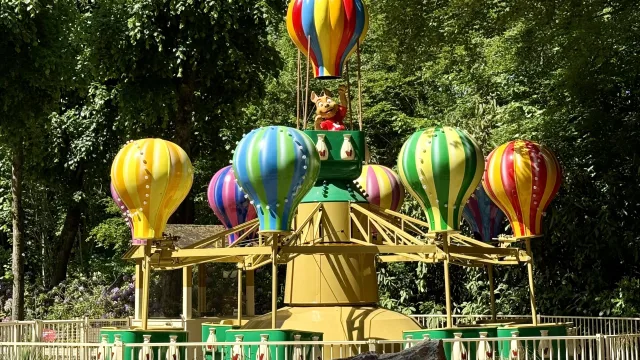
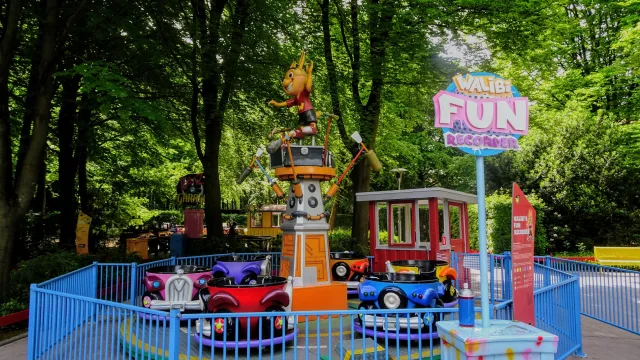
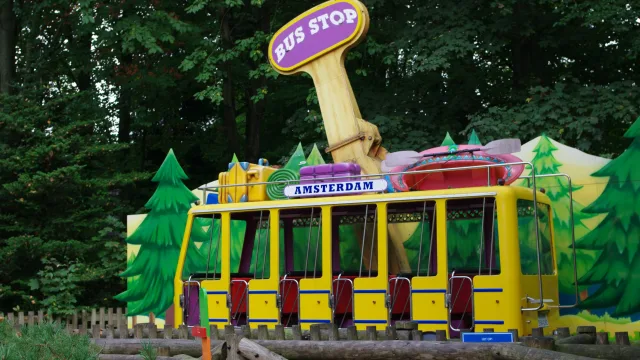
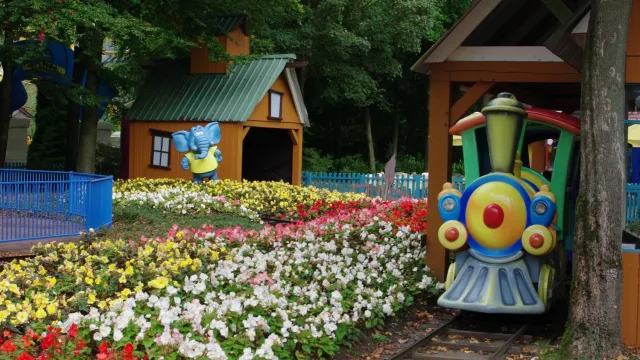
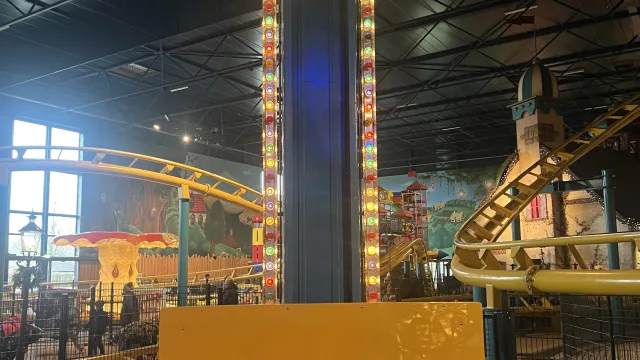
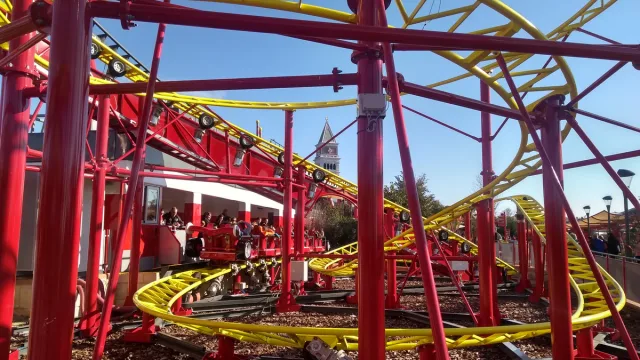
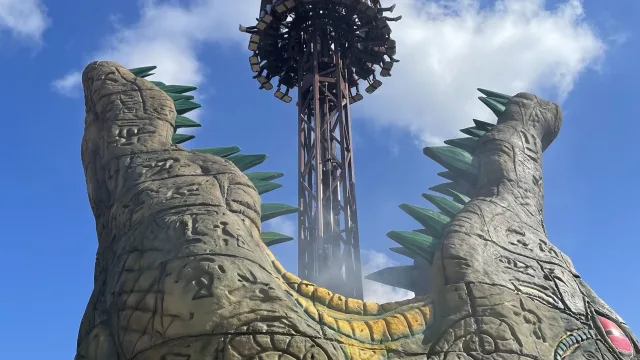
Internationally, the manufacturer is visible through compact coasters and family installations. Junior Red Force at Ferrari Land shows how a small coaster model can operate inside a major branded environment. Walibi Holland features multiple SBF Visa children's and family rides in its themed areas. Toverland uses early installations such as Klokhuis, Morrels Truckjes and Vliegend Tapijt as part of its family-friendly offer. Chessington World of Adventures added several recent SBF Visa rides to the World of Jumanji area, including Mamba Strike and Ostrich Stampede. The manufacturer's profile therefore lies less in headline records than in repeatable, thematically flexible systems that help parks broaden their offer for younger guests and families.
History
The history of SBF Visa begins, according to company information, in 1952. That year Italo Frison founded SBF in Casale di Scodosia, a town in the province of Padua known for craft production and small workshops. The first activities were modest: miniature cars, vehicles for children's rides and small pavilions. The company developed from manual metalworking and local supply rather than from a large industrial corporation. Its portfolio therefore grew gradually with demand from Italian fairs, leisure operators and later fixed parks.
During the following decades SBF moved from simple children's products toward a broader catalogue. Small carousels, jets, convoy rides and themed units gave operators recognizable attractions that were relatively easy to transport, install and maintain. The Italian amusement ride industry included several family companies rooted in steelwork, coachbuilding or scenic production; SBF belonged to that tradition, but distinguished itself by developing a large number of standard variants. The partnership with Visa International strengthened sales, export and product presentation, after which the name SBF Visa Group became the international umbrella.
From the 1990s onward, the second generation of the family became involved in the company. The official history points to the role of Vittorio and Sandro in the further expansion of the business. That period coincided with a stronger international orientation. Amusement parks were looking for affordable additions for young visitors, while indoor centers and regional parks needed compact attractions that did not require the scale or budgets associated with major roller coaster builders. SBF Visa could respond with installations that combined standard engineering with color, decoration and comparatively short delivery times.
In the 2000s and 2010s the group became more visible through coasters and larger family projects. It developed several spinning coaster and family coaster models, often offered on a self-supporting base or with limited civil works. RCDB lists the spinning coaster line as an ongoing product type from 2014, and parks in Europe, North America, Asia and the Middle East added compact installations to their lineups. At the same time the company continued to supply children's rides and travelling thrill rides. Recent communication emphasizes seven production plants, a showroom with operating rides, about 250 rides per year and certification processes for different markets. SBF Visa has therefore grown from a small workshop into an export-oriented manufacturer with a clear position in the family and children's segment.
Innovation and technology
The technical core of SBF Visa lies in modularity and repeatable family engineering. Many models use a compact steel structure, simple drive systems and standardized vehicles that are adapted for each project with color, figures and scenic elements. In roller coasters and track rides this often means a limited footprint, manageable track length and installation methods that reduce civil preparation. Official product information for the Spinning Coaster 2.0, for example, emphasizes a self-supporting base, availability as a park or trailer model and assembly without traditional foundations in suitable configurations.
Production is vertically organized. SBF Visa describes in-house departments for design, metal fabrication, fiberglass work, electrical systems, assembly and control. Fiberglass is used for vehicles, characters, decorative fronts and themed bodies, while steel fabrication supplies structural components, columns, track and frames. Electrical systems and controls are prepared within the production process, after which rides can be tested before delivery. This combination suits a manufacturer that sells many standard models in different versions: the base remains recognizable, while the appearance can be adapted to a park area or branded environment.
Safety and certification are strongly present in the sales process. The company refers to pre-installation testing, material certification, non-destructive examination and cooperation with bodies such as TUV, LGA, Bureau Veritas and national inspection organizations. That matters because SBF Visa supplies both travelling and fixed installations and therefore faces different standards in Europe, North America, the Middle East and other markets. Its technical philosophy is usually not aimed at extreme height or speed, but at predictable loads, easy maintenance, short downtime and a clear ride experience for children and families.
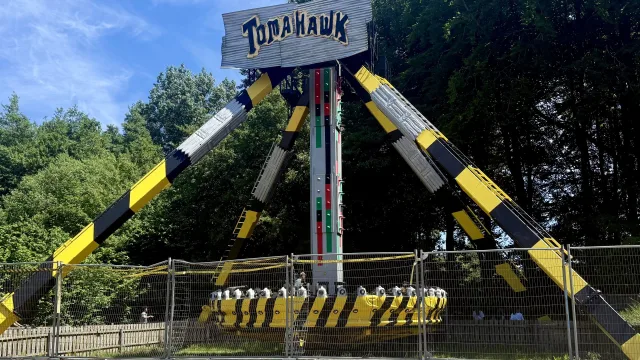
In thrill rides such as Dance Party variants, Airborne Shot, Reverse Time or Sky Glider, the emphasis is on rotation, lifting, tilting and visual intensity within a compact machine. In children's and family rides it is more often about slow-moving vehicles, repeatable cycles, low boarding height and strong recognizability. This approach gives SBF Visa a practical position in parks that expand their offer in phases: the technical systems are not revolutionary in every individual project, but their strength lies in repeatability, adaptability and a production process that can support many ride families in parallel.
Industry impact
SBF Visa's influence on the amusement industry is most visible in the middle market: parks, fairs and indoor venues that need affordable, compact and family-friendly capacity. Where major roller coaster manufacturers are often associated with records, complex layout studies and long investment programs, SBF Visa supplies many attractions that can be planned into an area more quickly. This makes the company important for regional parks and international groups that want to serve young audiences without launching a large-scale thrill project.
One important effect is the normalization of compact coaster models as a family tool. The manufacturer's spinning coasters and small family coasters appear in parks that might otherwise have added only flat children's rides. They give children a first coaster experience, increase the visibility of a children's area and can be dressed thematically without changing the entire site. Junior Red Force at Ferrari Land is a good example: the ride is not a major record coaster, but it translates the Ferrari theme into an accessible first coaster.
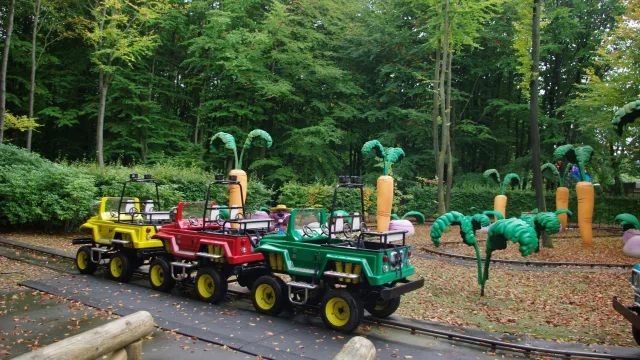
SBF Visa has also contributed to the spread of standardized ride families with many decorative variants. Attractions such as Jump and Smile, mini jets, convoy rides and compact towers return in different themes, from farm and adventure to motorsport and jungle. This lets parks with relatively limited resources create areas that still feel visually coherent. The manufacturer's impact therefore lies mainly in scale, repeatability and international availability. Its contribution is less iconic in any single machine, but significant in the way modern family areas can be made affordable, colorful and quickly programmable.
Current operations
SBF Visa Group operates from northeastern Italy, with official addresses for SBF srl in Casale di Scodosia and Visa International srl in Montagnana. The company communicates a production structure with seven plants between Padua and Rovigo, more than 150 employees, a comparable network of external collaborators and annual output of about 250 rides. According to the manufacturer, its showroom contains dozens of operating models, allowing customers to inspect and test rides before ordering.
Current activities include design, engineering, production, theming, certification support, installation, training and spare parts service. The portfolio is organized across thrill rides, family rides, coasters, towers and children's rides. The group supplies fixed amusement parks, travelling operators, indoor venues and leisure projects across several continents. Service is an explicit part of the company's proposition: SBF Visa refers to spare parts, technical support and 24-hour availability. For new projects the group positions itself not only as a machine builder, but also as a partner able to support layout, decoration, inspection, commissioning and training. This keeps standard models useful for very different locations, from compact children's areas to individual family additions in large resorts.
Design philosophy
SBF Visa's design philosophy is pragmatic, colorful and modular. The company appears to design attractions from the question of how an operator can quickly add a recognizable experience without heavy infrastructure or highly specialized operation. Rides need to be understandable for children, reassuring for parents and useful for parks in terms of capacity and maintenance. This explains the emphasis on compact footprints, standard vehicles, cheerful figures and thematic variants.
In family coasters and track rides, the philosophy centers on first experiences: not the highest speed, but a ride younger visitors dare to try and want to repeat. In travelling thrill rides, SBF Visa instead seeks clear movements that are visible from the midway, such as rotation, tilting or lifting. In both cases operation is central. The manufacturer does not design abstract showpieces, but practical tools for parks and fairs that must remain reliable, recognizable and visually adaptable. The result is a design language in which fun should be legible even before the guest boards.