Company profile
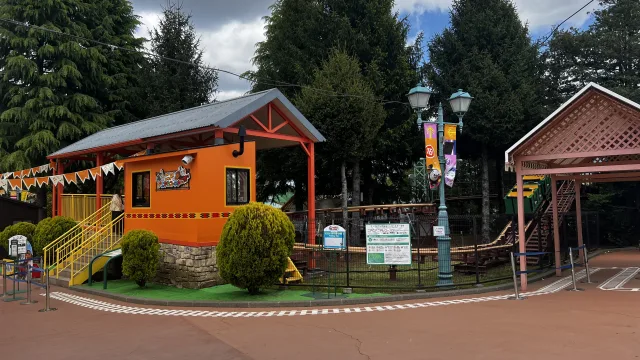
Sansei Technologies, Inc. is one of the most important Japanese companies at the intersection of amusement ride engineering, stage machinery, elevators and custom motion systems. The company was established on February 27, 1951 as Sansei Yusoki and, according to its own history, began as a manufacturer of elevators, escalators and amusement rides. Stage equipment was added in 1952, giving Sansei a broad motion technology foundation at an early stage. That combination explains the company s identity: Sansei does not treat attractions as isolated decorative objects, but as mechanical systems in which lifting, rotating, guiding, braking, opening, closing and synchronization are central. For W8baan, the direct production link is Nia and Animal Coaster at Fuji-Q Highland. That mini roller coaster in Thomas Land is a small example of Sansei s family oriented product side, but the manufacturer has a much wider position. Official Sansei sources list dark rides, omnimovers, observation towers, water rides, family rides and custom solutions. The company emphasizes an integrated chain from concept development, machine design and engineering to manufacturing, installation, maintenance and refurbishment. Sansei therefore resembles a technical system integrator as much as a conventional catalogue ride supplier. Its international significance grew strongly after 2012. That year, TELMIC and S&S Worldwide joined the group, adding American thrill ride and roller coaster technology to the Japanese engineering base. In 2014, the company adopted the Sansei Technologies name to express a stronger focus on technology and quality improvement. In 2018, Sansei acquired Vekoma Rides in the Netherlands, adding a major European roller coaster manufacturer. In 2023, FORREC joined the group, strengthening master planning, concept development and experience design. Sansei is therefore important to W8baan as the builder of a specific Fuji-Q attraction, but also as the parent company behind an international chain of ride engineering, theme park design and long term service. This makes the company more than a supplier of individual ride systems: it is also a platform for parks that want concept design, engineering, installation and lifecycle support to be coordinated early in a project. In Japan, Sansei remains visible through compact family rides and specialist park hardware, while S&S, Vekoma and FORREC give the group a much wider international reach. For an attraction encyclopedia, Sansei is especially relevant because it connects Japanese mechanical engineering with dark ride systems, observation towers, water rides and contemporary coaster development within one global organisation. Its long experience with projects where motion, throughput and show value meet gives the company a broader profile than that of a pure coaster builder.
History
The history of Sansei Technologies begins in 1951, when Sansei Yusoki was established in Osaka in the context of Japan s postwar reconstruction. Its early activities covered elevators, escalators and amusement rides, and stage equipment was added as early as 1952. In that same year, according to Sansei s own company information, it delivered the first Japan made roller coaster to Takarazuka Family Land. The company therefore stood near the beginning of Japan s amusement ride industry before modern theme parks became dominant. In the following years, Sansei grew with the demand for complex motion systems. It worked on theatres, halls, elevators, moving walkways, amusement rides and special constructions. Expo 70 in Osaka was a major milestone: Sansei supplied moving walkways, stage mechanisms, roller coasters, rapids slides and unusual systems there. The world exposition demonstrated that Sansei could apply motion and transport engineering on a large public scale. In the following decades, Sansei became a regular supplier for Japanese parks, theatres and public buildings. The company also developed a maintenance structure through Sansei Maintenance, Sansei Facilities and other group companies. From 2012 onward, the scale changed. TELMIC and S&S Worldwide joined the group, adding show technology and American ride engineering to the Japanese mechanical base. In January 2014, Sansei Yusoki changed its name to Sansei Technologies. In 2018, Vekoma Rides was fully acquired, and in 2023 FORREC was added. Through these steps, Sansei changed from a Japanese technical manufacturer into a global group for attractions, stage systems, design, production and life cycle support. A recurring theme in this history is Sansei’s movement between public infrastructure and leisure experiences. The same organisation that developed stage and transport systems also delivered equipment for world expositions, theme parks and compact park attractions. The group-building phase from 2012 changed the company’s profile substantially: Sansei evolved from a mainly Japanese supplier into an international organisation combining ride engineering, themed design knowledge and after-sales support.
Innovation and technology
The technical foundation of Sansei Technologies is broader than amusement ride building alone. The company describes the technology of moving things as its core, and that is visible in the combination of elevators, stage systems, amusement rides and specially designed installations. In attractions, this means that Sansei is strong in controlled motion: guiding vehicles, lifting cabins, rotating platforms, programming ride paths and maintaining safety functions. The dark ride products show this approach clearly. Sansei supplies track based dark rides with individual vehicles, suspended dark rides, trackless dark rides with independently programmable vehicles, onboard audio, lighting and interactive systems. The small turning radius of some systems allows installation in existing buildings. Omnimovers use mechanically connected vehicles to create a continuous guest flow with high capacity and all weather indoor operation. Observation towers combine elevator technology, rotation, structural calculations, evacuation planning and guest comfort. Sansei s official LEGOLAND Korea project story shows how project management, local building codes, factory testing, high altitude assembly and cooperation with local contractors are part of its engineering philosophy. The product logic is therefore not just designing a ride, but controlling the full process from specification to maintenance. Through S&S Worldwide, the group adds pneumatic launches, tower rides, Screamin Swing type thrill rides and compact roller coaster concepts. Through Vekoma, family and thrill coasters, special attractions and after sales services in Europe and beyond are added to the network. Sansei therefore treats technology as a life cycle: design, fabrication, installation, testing, maintenance and later refurbishment. Across the group, the engineering mix ranges from slow rotating observation cabins and continuous omnimovers to compact children’s coasters and dynamic coaster systems through S&S and Vekoma. That range requires early alignment between guest flow, redundancy, inspection access and themed integration.
Industry impact
Sansei Technologies influences the amusement industry on two levels. The first is Japanese and historical. According to its own sources, Sansei delivered the first Japan made roller coaster in 1952 and worked early on amusement rides, elevators, moving walkways, stage systems and Expo installations. The company therefore helped build the technical infrastructure through which Japanese parks, theatres and public events could develop. The second level is international and strategic. By adding S&S Worldwide, Vekoma and FORREC to the group, Sansei connected Japanese motion engineering with American thrill ride innovation, European roller coaster engineering and Canadian experience design. The group is now present across several links in the value chain: concept, master planning, ride engineering, manufacturing, installation, service and refurbishment. For parks, this matters because modern attraction projects are increasingly multidisciplinary. A dark ride requires vehicle technology, show control, scenery, capacity, accessibility and maintenance. A roller coaster requires mechanical design, production, safety standards and after sales support. A new themed land also requires conceptual coherence. Sansei s impact is therefore less visible in one single iconic product than in the way the group combines different forms of expertise. Within W8baan, the link with Nia and Animal Coaster shows that even small family coasters are part of this larger Japanese and international motion technology network.
Current operations
Sansei Technologies is active as a listed company on the Tokyo Stock Exchange Standard Market. Official company information states consolidated sales of JPY73,070 million and 1,405 employees as of March 31, 2026. The main activities are amusement rides, stage equipment and elevators, alongside special solutions and group activities. For FYE3/2026, Sansei reports that amusement ride projects in Japan and overseas progressed smoothly and that demand for spare parts remained solid. The group operates with a head office in Osaka, a Kobe plant, offices across Japan, a representative office in Thailand and international group companies in the United States, the Netherlands and Canada. S&S Worldwide supplies rides and roller coasters from Utah, Vekoma supplies roller coasters and special attractions from Vlodrop, and FORREC provides concept and design services from Toronto. Current operations are therefore both industrial and service oriented: Sansei sells new systems, but also supports existing installations through maintenance, inspections, parts, refurbishment and life cycle management.
Design philosophy
Sansei s design philosophy revolves around reliable motion. Rather than treating an attraction only as spectacle, the company treats movement as usable technology that must be safe, comfortable, maintainable and adaptable. This is visible in the spread of the portfolio: a dark ride vehicle, an omnimover, an observation tower, a stage lift and a special industrial system have different forms, but all require precise control and trust. Sansei speaks of bringing smiles through motion technology, and that phrase fits the combination of engineering and guest experience. For parks, this means that the technical base is not separate from the visitor journey. Capacity, comfort, safe boarding, inspectability, maintenance and thematic freedom belong to the same design problem. Within the group, that philosophy expands: S&S adds thrill and dynamics, Vekoma combines engineering with creative layout development, and FORREC brings spatial storytelling and concept design. Sansei s design thinking is therefore systemic: first understand what kind of movement an experience needs, then build a reliable machine that can continue to work for years.