Profile
About Hugh Phillips Engineering
Hugh Phillips Engineering is linked as manufacturer to 3 active attractions across 1 parks on W8baan.
You can temporarily save favorites in cookies. Create a free account or log in to use them on every device.
You have no favorite parks yet. Tap the star on a park to add one.
Hugh Phillips Engineering was a small Welsh locomotive and mechanical engineering specialist based in Tredegar. Its main relevance to the attractions industry comes from the three 3 ft gauge steam locomotives and fifteen coaches built for the Euro Disneyland Railroad. The company also worked on heritage steam locomotives, Sudan Railways equipment and railcars. Although the business disappeared in the 1990s, its Disney-built train sets remain a visible part of Disneyland Paris.
Hugh Phillips Engineering is linked as manufacturer to 3 active attractions across 1 parks on W8baan.
Share of measured operating time in which the rides were open. Outages and maintenance count as downtime; closed and unknown do not count.
21.5 h measured operating time
762.1 h measured operating time
1,332 h measured operating time
Spread of roller coaster lengths based on available RCDB data for this manufacturer's attractions.
Not enough data yet for a boxplot.
Hugh Phillips Engineering occupies a niche position in the attractions industry. It was not a conventional amusement ride manufacturer and did not develop roller coasters, dark rides or themed show systems. The company came from the British railway engineering world and specialised in mechanical work on steam locomotives, including valves, cylinders, motion components and refurbishment. That background made it relevant to theme parks seeking an authentic railway experience. For Euro Disneyland, later Disneyland Paris, Hugh Phillips Engineering built three oil-fired 4-4-0 steam locomotives and fifteen coaches for the Euro Disneyland Railroad in the early 1990s. The locomotives W.F. Cody, C.K. Holliday and G. Washington drew on the American Disney railroad tradition, but were built in Wales for a French park with international guest expectations. The project combined heritage appearance, operating capacity and modern safety requirements. The trains had to look like nineteenth-century American locomotives while operating every day in a busy theme park with high availability, fixed dispatch patterns, multilingual guest flows and disciplined maintenance. Beyond Disney, Hugh Phillips Engineering worked on more industrial railway assignments. Sources connect the company with the overhaul of Great Western Railway locomotive 2857, improvement work on Sudan Railways steam locomotives for grain haulage and the building of diesel railcars for Sudan, Mozambique and related later projects. After financial problems in 1992, the activity continued under the HPE Tredegar name, which built diesel-electric rack railcars for the Snowdon Mountain Railway. The company or its successor did not retain a long-term market position and had disappeared from active industry by 1996. Its legacy is therefore small in volume but unusually visible. Where many ride manufacturers are remembered for broad catalogues, Hugh Phillips Engineering is remembered chiefly for one prominent Disney project and for a series of railway engineering commissions where craft knowledge mattered more than brand recognition. For W8baan the profile is also relevant because the manufacturer is linked in the database not only to a machine, but to stations and ride points of the Disneyland Railroad. That requires careful interpretation. Hugh Phillips Engineering did not build the station architecture of Main Street Station or Frontierland Depot; those belong to Disney Imagineering and the park designers. The link concerns the moving system serving those stations. The company therefore supplied a core component of the attraction experience: the locomotives and coaches that make the circuit through Main Street U.S.A., Frontierland, Adventureland, Fantasyland and Discoveryland possible. This is why the company belongs in an attractions encyclopedia despite its railway background. Its story connects European narrow-gauge and heritage engineering with the American Disney idea that train travel can be transport, show, pacing and park dramaturgy at the same time.
The history of Hugh Phillips Engineering is less fully documented than that of major ride or railway manufacturers. A published locomotive-builder profile gives 1981 as the founding year and Tredegar in South Wales as the base. By 1982 the name appears in restoration sources for Great Western Railway locomotive 2857, where the company carried out precision work on cylinders and valves. That early project shows the company’s core strength: heavy mechanical work on historic steam machinery, with tight tolerances and practical knowledge of existing locomotives. In 1985 and 1986 Hugh Phillips Engineering became involved in refurbishing and improving six Sudan Railways 2-8-2 steam locomotives for grain haulage. Modern-steam sources note that project engineer Phil Girdlestone worked with the company during that period and designed improvements such as Lempor exhausts for the Sudan locomotives. In 1989 diesel railcars followed for Sudan and Mozambique. The most important attraction-related commission came around 1991, when the company built three 3 ft gauge steam locomotives and fifteen coaches for the Euro Disneyland Railroad. When Euro Disneyland opened on 12 April 1992, these trains formed an essential part of the park experience. The visibility of the Disney project did not remove the company’s financial vulnerability. In 1992 the original business structure ran into serious difficulty and activity continued under the HPE Tredegar name. Under that name, projects followed for Ghana, Tanzania and the Snowdon Mountain Railway. The three diesel-electric rack railcars for Snowdon in 1995 were technically ambitious, but the successor business also failed and disappeared in 1996. In later memory, the Disney equipment remained the most public part of the legacy, while the other projects live mainly in railway history sources. The historical sources also show that the company moved continuously between restoration, export work and new construction. That helps explain why the company name appears differently in different contexts and why the archive trail is fragmentary. For a small firm, commissions in Sudan, France and Wales were unusually international. At the same time, such contracts exposed the organization to cash-flow pressure, liability, technical support obligations and project risk. The move to HPE Tredegar was therefore not ordinary expansion, but an attempt to keep knowledge and ongoing activity alive after financial distress.
Hugh Phillips Engineering’s technology was not about spectacular ride layouts, but about railway mechanics. The company worked with steam locomotives in which valve motion, cylinder lining, bearings, brakes, boiler use and traction are continuously connected. On the GWR 2857 project the task involved machining old cylinder and valve bores, restoring fits and producing new components within tight tolerances. That kind of work requires a different discipline from serial new-build production: the engineer must combine existing wear, historic dimensions and modern safety expectations. On the Sudan Railways contract, performance improvement was added to refurbishment. The involvement of Phil Girdlestone and the use of Lempor exhaust principles point to concern for better draughting, lower fuel use and more efficient steam flow. For the Euro Disneyland Railroad, Hugh Phillips Engineering translated that railway craft into a theme park context. The 4-4-0 locomotives had to match American nineteenth-century railway iconography while functioning as reliable park vehicles. Oil firing made operation more controllable than coal in a busy resort. The passenger coaches had to handle large guest flows in line with Disney’s operating standards. The HPE Tredegar railcars for Snowdon show another technical direction: diesel-electric drive combined with rack operation for steep mountain railways. Across these projects the common thread is clear: established railway principles were adapted to specific operating environments rather than sold as a standard catalogue. Scale also mattered. A theme park railway is not a museum object running occasionally, but a public machine with service hours, queues and repeated starts and stops. The designer must consider drivers, conductors, braking procedures, communication, coach capacity, evacuation and the experience of passengers who often know little about railways. Hugh Phillips Engineering therefore had to translate historical forms into a manageable operating asset. At Snowdon the challenge was the opposite: landscape dominated the design, with steep gradients, rack safety and mountain weather. The company’s technical reputation therefore rested on adaptation to context, not on one uniform product line.
Hugh Phillips Engineering’s impact is narrow but noteworthy. The company did not create a new attraction category and had no global amusement sales network. Its importance lies at the intersection of heritage railways and theme park operation. Disneyland Paris chose real steam trains as part of its park identity, and the locomotives built by Hugh Phillips helped make that choice credible. In that way a small Welsh company contributed to one of Europe’s most visited theme parks. The story also shows how vulnerable specialist engineering firms can be. A highly visible Disney contract, international railcar work and restoration assignments were not enough to guarantee a sustainable business. For the attractions sector, the lesson is that historically styled experiences often depend on small, highly specialised suppliers outside the conventional amusement industry. Their work can disappear from marketing material, yet it determines the reliability, safety and authenticity of the guest experience. Hugh Phillips Engineering therefore deserves an encyclopedic place chiefly as a hidden railway partner behind an iconic Disney attraction. The company also illustrates a wider truth about theme park history: not every important contributor is a recognizable amusement brand. Parks often combine suppliers from civil engineering, railway engineering, scenic construction, audiovisual systems and safety technology. Hugh Phillips Engineering belongs to that second layer of specialists. Without such companies, many historically styled attractions would remain decorative but technically less convincing. The Disney trains show that a railway in a park can provide capacity, orientation, nostalgia and landscape transition at the same time. For enthusiasts, the manufacturer is therefore a small but meaningful reminder that attraction history is not written only by famous ride builders.
Hugh Phillips Engineering is no longer active. Dark Ride Database gives 1996 as the company’s end, and company-register sources show related legal entities later dissolved or entering liquidation. No official website or current commercial successor under the same name has been found supplying attraction or railway equipment. The operational legacy consists mainly of installed equipment. The Disney locomotives W.F. Cody, C.K. Holliday and G. Washington remain part of the Disneyland Railroad system at Disneyland Paris, where maintenance is handled by the park organization and specialist railway partners. Other projects, such as HPE Tredegar railcars for Snowdon, are primarily of historical relevance. For operators this means Hugh Phillips is no longer a supplier, but a historical manufacturer whose documentation, parts knowledge and maintenance experience reside with operators, specialists and railway communities. Future documentation should treat sources critically. Some databases record Hugh Phillips only as the builder of three locomotives, while theme park sources list the firm as a ride-system supplier for the Disneyland Railroad. Both perspectives are useful, provided it remains clear that Disney designed the attraction concept and themed environment.
Hugh Phillips Engineering’s design philosophy can best be understood as railway pragmatism. The company did not design spectacle for its own sake, but asked how a vehicle could operate safely, maintainably and credibly in a specific environment. In restoration work that meant respecting historic dimensions while being willing to remachine or improve worn components. In the Disney locomotives it meant balancing visual nostalgia with modern park operation: a train had to look historically convincing, carry many guests, run predictably and remain available day after day. In Sudan and Snowdon the design challenge centred on traction, fuel use, robustness and adapted technology for difficult conditions. The common thread is modest but strong: engineering had to serve reliability and context. That philosophy fits small workshops that rely on craft knowledge rather than catalogues. Design begins with what the machine must do, who operates it, how it is inspected and what historical impression it should create. Appearance and engineering are therefore not separate. A Disney locomotive had to be scenic object, transport system and maintainable vehicle at the same time.
A locomotive-builder database lists Hugh Phillips Engineering as founded in 1981 with headquarters in Tredegar, Wales.
The company is documented machining cylinders and valve chests for the restoration of Great Western Railway locomotive No. 2857.
Hugh Phillips Engineering is associated with refurbishment and performance improvement of six Sudan Railways steam locomotives.
Sources report diesel railcars for Sudan and Mozambique, showing the company moving beyond steam refurbishment into new rail vehicle work.
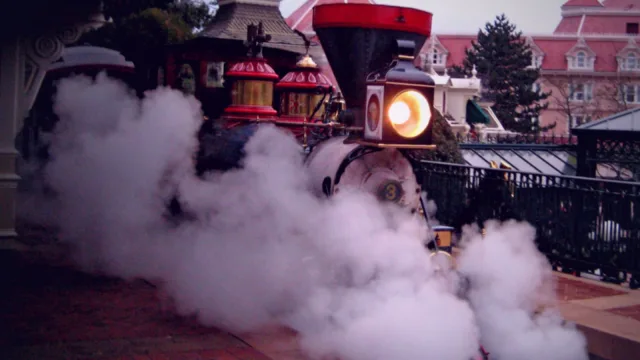
The company builds three 3 ft gauge 4-4-0 steam locomotives and fifteen carriages for the Euro Disneyland Railroad.
The Euro Disneyland Railroad opens with Hugh Phillips built rolling stock as part of the park’s opening-day transport and show experience.
Sources mention an Irish Railways railcar, while public company records and secondary sources indicate severe financial difficulties around this time.
Activity continues under the HPE Tredegar name, linked to later railcar projects outside the theme park market.
HPE Tredegar builds three diesel-electric rack railcars for the Snowdon Mountain Railway in Wales.
Dark Ride Database and railway sources describe the company lineage as going out of business in 1996.
Companies House records show Hugh Phillips Engineering (Projects) Limited dissolved in 2020 after earlier liquidation history.
Disneyland Paris · 1992
Disneyland Railroad · 1992
Disneyland Railroad · 1992
Disneyland Railroad · 1992
Disneyland Paris · 1992
Disneyland Paris · 1992
Disneyland Paris · 1992
Disneyland Paris · 1993
Severn Valley Railway · 1982
Sudan Railways · 1985-1986
Sudan Railways · 1989
Railway operator in Mozambique · 1989
Irish Railways · 1992
Snowdon Mountain Railway · 1995
Railway operator in Ghana · 1990s
Railway operator in Tanzania · 1990s
3 linked attractions