Company profile
Custom Coasters International, Inc., usually shortened to CCI, was one of the defining wooden roller coaster builders of the 1990s. The company was founded in 1991 in West Chester, Ohio, by Denise Dinn Larrick, Randy Larrick and Jeff Dinn. The Dinn family name connected CCI to an older American wood-coaster tradition: Denise was the daughter of Charles Dinn, whose Dinn Corporation had built and relocated wooden coasters during the 1980s. CCI carried part of that knowledge forward, but gave it a more aggressive and international character. RCDB credits the company with 34 built roller coasters, many of which still exist.
CCI stood out by delivering wooden rides that were intense, comparatively affordable and strongly adapted to their sites. While many classic wooden coasters used broad and regular out-and-back profiles, CCI often favoured strong lateral forces, quick directional changes, low-to-the-ground turns and terrain-following routes. The company worked with designers and engineers such as Larry Bill, Dennis McNulty, Mike Boodley, Bill Kelley, Chad Miller, Korey Kiepert and Michael Graham. Its identity was therefore not only carpentry, but also structural engineering, cost control and the ability to exploit existing topography.
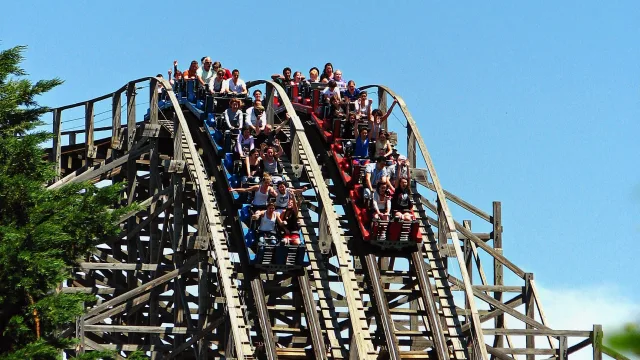
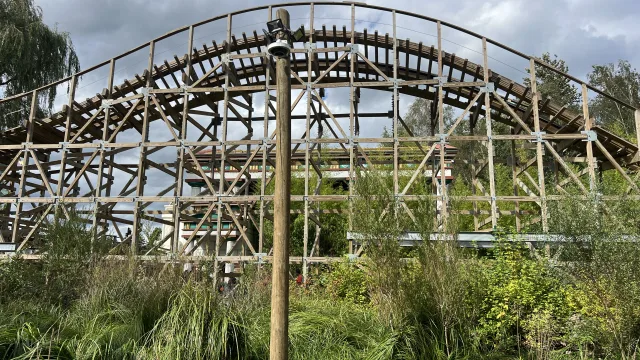
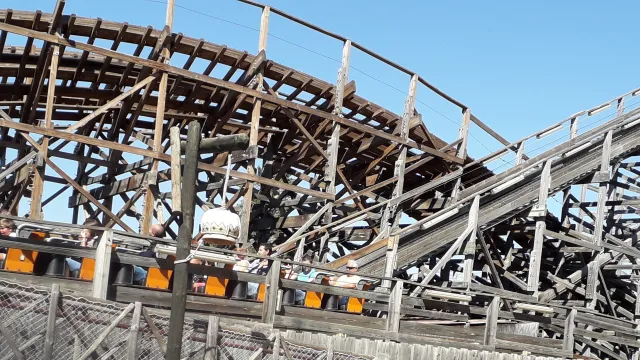
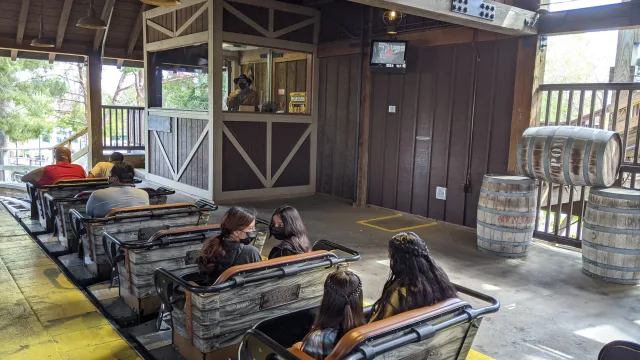
In W8baan, CCI is most visible through three active European installations. Stampida and Tomahawk at PortAventura Park opened in 1997 as part of the Far West area: Stampida as a twin-track racing wooden coaster and Tomahawk as a smaller family coaster winding through and around the larger structure. Tonnerre de Zeus, now Tonnerre 2 Zeus, opened the same year at Parc Astérix and was later substantially renewed by The Gravity Group and Gravitykraft. These three rides show how CCI worked outside North America: with park-specific themes, large timber structures and layouts that remained recognisable despite later trains, retracking and modernisation.
The manufacturer had a short but highly productive peak. In the United States and beyond it delivered Kingdom Coaster, The Raven, Megafobia in Wales, Shivering Timbers, GhostRider, Tremors, The Boss, Boulder Dash, Medusa and New Mexico Rattler, among others. Its financial base proved fragile. In 2002, while New Mexico Rattler was still under construction, CCI filed for bankruptcy and was liquidated. Its legacy remained considerable: Denise Dinn Larrick moved to S&S, while Larry Bill, Chad Miller, Korey Kiepert and Michael Graham founded The Gravity Group. CCI’s influence therefore continues in modern wooden coasters, retracking work, Timberliner trains and the wider revival of dynamic wood-coaster design.
Importantly, CCI did not simply sell one standard model, but created local interpretations of wooden coaster construction. Its rides therefore differ strongly in scale, atmosphere and maintenance history. Some were later softened or technically renewed, while others remained known for their raw character. This makes the manufacturer historically important: CCI represents a transition between classic American timber construction and the later generation of specialised renovation and design firms.
History
The history of Custom Coasters International begins in the aftermath of the Dinn Corporation. Charles Dinn had played an important role in the return of new wooden coasters in the United States during the 1980s, but his company ended in the early 1990s. In 1991 Denise Dinn Larrick, Randy Larrick and Jeff Dinn started a new business in West Chester, Ohio. The first years produced smaller and medium-sized projects, including Kingdom Coaster at Dutch Wonderland and Outlaw at Adventureland. The company quickly gained a reputation for delivering wooden coasters with strong character at comparatively manageable cost.
Growth accelerated from 1995. The Raven at Holiday World showed how CCI could turn a compact wooded site into an intense ride. It was followed by projects such as Timber Terror, Megafobia, Tonnerre de Zeus, Stampida, Tomahawk and Shivering Timbers. The European projects of 1996 and 1997 were especially important: Megafobia gave Oakwood international visibility, while Tonnerre de Zeus and the PortAventura pair made CCI visible at major European parks.
Around 2000 CCI reached its highest production volume with rides such as The Boss, Boulder Dash, Medusa, Mega Zeph, Hurricane and The Legend. That rapid growth also increased pressure on a relatively small organisation. In 2002 the company ran into financial trouble while New Mexico Rattler was not yet complete. The park ultimately finished the ride itself. After the closure, the knowledge dispersed: Denise Dinn Larrick moved to S&S and a group of CCI designers founded The Gravity Group, which later also renewed CCI-built rides.
The name evolved from Custom Coasters Incorporated to Custom Coasters International as the order book became more international. That ambition appeared relatively early: CCI worked not only for regional American parks, but also for Wales, France, Spain and Mexico. For a young wooden coaster builder this was unusual, because transport, local construction crews, standards and park expectations differed sharply from country to country.
Innovation and technology
CCI specialised in wooden roller coasters using traditional track, wood or steel support structures and trains supplied by outside companies such as Philadelphia Toboggan Coasters. Its technical core was layout and structural integration. The rides were often routed low through forests, hills or existing park areas, making speed and lateral forces feel stronger than the absolute height suggested. On Stampida and Tomahawk, CCI used the visual power of intertwined timber structures; on Tonnerre de Zeus and Boulder Dash, the landscape became part of the ride.
The company was known less for patented hardware than for design choices: quick airtime hills, sharp transitions, long ride durations, heavy timber presence and a preference for dynamic routes adapted to each site. Some projects used steel support structures beneath wooden track, which could simplify maintenance and integration on unusual terrain.
The drawback was that many CCI rides demanded intensive maintenance. Later refurbishments by Great Coasters International, The Gravity Group, Gravitykraft, Rocky Mountain Construction or local park teams show that the original layouts remained valuable, but could need modern track systems and trains to preserve comfort and reliability.
CCI’s technical method usually started with the desired ride sensation. The lift hill, first drop and turns were not designed separately from the surroundings, but as a sequence of moments that had to preserve speed. Engineers therefore had to combine timber bents, foundations, diagonal bracing and track geometry with the available building envelope. On racing or duelling rides, timing was an additional concern: both tracks had to interact visually without becoming operationally dependent on perfect synchronisation. Trains were often supplied by specialist vendors, allowing CCI to focus on layout, timber structure and construction coordination.
Industry impact
CCI’s influence is larger than the company’s short life suggests. During the 1990s it helped make wooden roller coasters exciting again for parks that did not always have giant steel-coaster budgets. Rides such as The Raven, Megafobia, Shivering Timbers, GhostRider and Boulder Dash drew attention from enthusiasts and trade observers, shifting the image of the modern wooden coaster from nostalgic to intense and competitive.
In Europe, CCI played a key role in spreading major wooden coasters beyond the United States. Megafobia, Tonnerre de Zeus, Stampida and Tomahawk proved that American-style timber construction could work in regional parks, themed landscapes and tourist destinations. In doing so, the company influenced how European parks could use wooden attractions as headline rides.
After 2002, the impact continued through people and techniques. The Gravity Group built on CCI experience, S&S experimented with a wooden division under Denise Dinn Larrick, and later refurbishments kept many CCI layouts relevant for new generations of riders.
CCI also affected the market position of independent parks. A regional park could install a CCI ride and suddenly appear in rankings and enthusiast discussions beside much larger destinations. That happened for Oakwood with Megafobia, Lake Compounce with Boulder Dash and Holiday World with The Raven and The Legend. The company helped turn the wooden coaster back into a marketing tool.
Current operations
Custom Coasters International is no longer operating. The company closed in July 2002 after bankruptcy problems, and no active official website or production line remains. Sources associate its former base with West Chester, Ohio. Existing CCI rides are now maintained by the parks themselves or by specialist suppliers for retracking, trains and structural renewal.
CCI’s current relevance therefore lies in operation and heritage rather than new orders. Stampida, Tomahawk and Tonnerre 2 Zeus remain active W8baan-linked rides, while other well-known coasters such as GhostRider, Boulder Dash and Shivering Timbers have been adapted to modern expectations through renovation and maintenance.
For parks, this means the manufacturer name now mainly lives in technical files, historical documentation and maintenance plans. When a CCI ride is renewed, the goal is often to preserve a valued original character while track, trains, brakes or structural elements are adapted to current safety and comfort expectations. No new CCI projects are built, but existing rides continue to deliver public value.
Design philosophy
CCI’s design philosophy revolved around energy, terrain and cost-conscious intensity. A CCI ride did not always need to be the tallest or fastest; it had to feel alive throughout its course. That was achieved with quick airtime, dense timber structures, unexpected lateral forces and routes that stayed close to the ground, trees, hills or other parts of the track.
The company often designed with a park’s limitations rather than around them. Stampida and Tomahawk share the same themed space, Boulder Dash follows a mountainside and Tonnerre de Zeus uses a long wooded area. That approach made CCI rides distinctive, but also required continuing maintenance to keep the original energy manageable.
The best CCI designs therefore feel less like geometric exercises and more like routes through a place. Riders experience a sequence of hills, tunnels, helices, headchoppers and forest edges, while the structure itself becomes part of the scenery. That philosophy suited parks that wanted a distinctive icon without the scale or cost of a hypercoaster. It also explains why many CCI rides, even after technical renovation, are still treated as recognisable original experiences.