Company profile
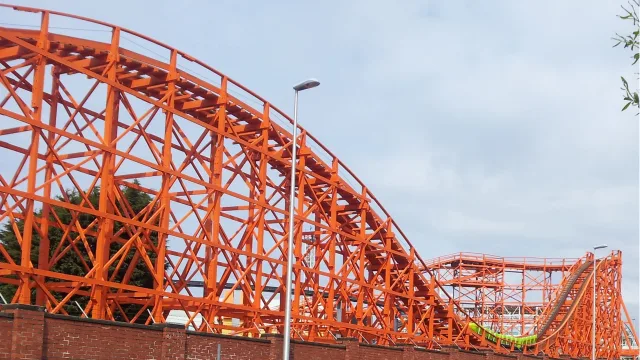
Charles Paige belongs to the generation of coaster builders who shaped the modern wooden roller coaster before the industry became a standardized global market. His work is harder to document than that of later companies because he operated mainly as an individual designer, builder and supervisor rather than as a continuing branded manufacturer. Even so, his name appears repeatedly in specialist sources around wooden rides that are central to British amusement history. RCDB describes him as one of the early American roller coaster designers and builders, born in Mifflinburg, Pennsylvania, later based in Milton and Los Angeles, and as the first student of John A. Miller. The same obituary note states that Paige began designing coasters in 1905 and worked on installations in the United States, England, France, Belgium and New Zealand. Within W8baan, Charles Paige is directly linked to Nickelodeon Streak at Pleasure Beach Resort, the wooden family coaster that opened in 1933 as Roller Coaster. RCDB and Coasterpedia identify Paige as builder and describe the reuse of the lift hill and other parts of the former Velvet Coaster. The ride later became part of Nickelodeon Land, making it a rare inter-war wooden structure still operating within a modern intellectual-property themed area. Paige’s strongest surviving heritage is wider than that single ride. Historic England describes Grand National as a 1935 wooden Möbius racing coaster designed by Charles Paige and Harry G. Traver, with a station by Joseph Emberton. The official park page also presents Grand National as Paige’s 1935 design and highlights the competitive twin-track experience. Historic England further connects Paige to Big Dipper, where he altered the route in 1935 to open up the park, and to Blue Flyer, where he supervised construction of a children’s wooden coaster using plans from Dayton Fun House and Riding Device and Manufacturing Company. These examples show that Paige did not only supply new rides; he also helped existing parks reshape circulation, capacity and family provision. His status is historical and inactive, with no present-day Paige company. The present value of the profile is therefore heritage and context: Paige’s work shows how American under-friction and timber coaster practice was translated into British seaside parks, where parts of that tradition remain visible to riders today. Because sources variously use builder, designer, supervisor and alteration credits, Paige is best understood as a practical project engineer. He stood between drawing board, timber construction, site logic and park operation. That explains why his name appears on new builds, modifications and supervised children’s coasters rather than within one simple corporate category.
History
Charles Paige’s career began, according to his Billboard obituary preserved by RCDB, in 1905, during a period when the American wooden roller coaster was rapidly professionalising. He was described as the first student of John A. Miller, a key figure in the development of under-friction wheels and safer high-speed coaster design. Paige therefore stood close to the technical transition from simple side-friction rides to modern wooden coasters with steeper profiles, higher speeds and more reliable wheel guidance. In the United States he worked on numerous installations and later became associated with National Amusement Device Company, a firm known for wooden coasters, kiddie coasters and park ride equipment. His international reputation is reflected in the note that he made installations in England, France, Belgium and New Zealand as well as the United States. During the 1930s Paige took on a particularly important role at Blackpool Pleasure Beach. After the closure of Velvet Coaster, the new Roller Coaster was built in 1933, later becoming Nickelodeon Streak. The ride reused parts of the earlier structure, a practice that fits the practical coaster building of the period: materials, space and existing infrastructure were combined into a new attraction. In 1934 came the children’s coaster now known as Blue Flyer, whose construction Historic England says Paige oversaw. In 1935 he worked on two decisive projects: he altered Big Dipper to support the spatial development of the park, and he designed Grand National with Harry G. Traver. Grand National became a rare Möbius racing coaster and is now one of Blackpool’s most important surviving wooden rides. Related British projects followed, including Cyclone at Southport and Texas Tornado at Morecambe. Paige remained active into old age. He died in 1951 in Myrtle Beach while supervising construction of a kiddie coaster for National Amusement Device Company. His history is therefore both American and transatlantic: he carried knowledge from the early American coaster industry into European seaside parks and left visible heritage behind.
Innovation and technology
Paige’s technical significance lies mainly in wooden coaster construction in the American tradition of the first half of the twentieth century. He worked in the era in which the under-friction wheel permanently changed the wooden roller coaster. Older side-friction rides depended more heavily on lateral guidance and modest profiles, while under-friction wheels made steeper drops, greater speed and stronger airtime possible. Paige was not a modern manufacturer with patented steel track systems, but a constructor who had to combine timber, steel fastenings, chain lifts, braking, station logistics and site planning for specific parks. Nickelodeon Streak shows a pragmatic technical approach: the 1933 ride reused the lift hill and parts of Velvet Coaster. Grand National shows a more ambitious side. Historic England describes the Möbius arrangement in which one continuous track forms two parallel circuits, making trains appear to swap sides without an actual crossing. That required careful spatial planning, station sequencing and ride timing. Big Dipper shows another ability: Paige could alter existing wooden structures, changing turns, dips and park passages so that the amusement park could keep growing around the ride. Blue Flyer represents the smaller family and children’s segment, where lower height and gentler forces did not remove the need for sound timber construction, train guidance and maintainability. His technology was therefore project-specific, material-conscious and closely tied to the operational reality of seaside parks. Later conservation also reveals the technical character of the work. The surviving Blackpool rides have received new braking systems, strengthening, bolted connections, trains or station changes over time while retaining their essential form. Paige’s designs therefore had to function on opening day and remain adaptable for later generations. That distinguishes them from temporary fairground structures: they became park infrastructure.
Industry impact
Charles Paige’s influence lies less in a globally recognized brand and more in the transfer of craft. He was a bridge between the American golden age of wooden coaster building and British seaside parks seeking modernisation during the inter-war years. Blackpool Pleasure Beach is the strongest evidence. Nickelodeon Streak, Blue Flyer, Big Dipper and Grand National together show how one designer could contribute to family provision, thrill provision, park circulation and heritage value. Historic England treats Grand National as rare because of its date, design, Möbius layout and survival, and identifies Paige as one of the designers whose remaining operating work is limited. That makes his legacy important for conservation and interpretation. His name also helps historic rides be understood not merely as nostalgic objects, but as deliberately engineered infrastructure. For modern parks Paige is not a current supplier, yet his work influences how heritage coasters are valued, restored and integrated into contemporary themed areas. Nickelodeon Streak is a clear example: a 1930s ride continues to operate inside a modern branded land. His influence is also visible in how specialist databases and heritage registers complement each other. RCDB preserves technical credits, Historic England provides legal and cultural interpretation, and parks continue to operate the rides. That allows an individual builder like Paige to remain legible inside a modern international attraction encyclopedia.
Current operations
Charles Paige has no current business operations. He died in 1951, and his name today functions as a historical designer and builder credit rather than as a supplier or service organisation. Present-day operation of his work sits with the parks and heritage bodies that manage the surviving attractions. Pleasure Beach Resort operates Nickelodeon Streak and Grand National, and presents Nickelodeon Streak as part of Nickelodeon Land. Grand National also has an official park page and a Historic England Grade II listing. Blue Flyer and Big Dipper are likewise protected or described by Historic England in relation to Paige’s work. Paige’s market position is therefore posthumous: his value lies in documentation, maintenance history, heritage status and the rideable survival of selected timber structures. For W8baan this means the profile should not be read as that of a current manufacturer, but as that of a historical maker whose influence continues through active and protected attractions.
Design philosophy
Paige’s known work suggests a design philosophy of practical intensity. He worked with timber, constrained sites and existing park structures, looking for solutions that were both exciting and operable. At Nickelodeon Streak this meant reusing parts of Velvet Coaster in a new family ride. At Big Dipper it meant adapting an existing landmark to changing park circulation. At Grand National it meant spectacle, competition and spatial elegance: the Möbius arrangement gives riders the feeling of a race while the engineering remains one continuous route. Paige’s designs therefore seem less focused on a single house style and more on solving specific park problems. He combined American coaster technique with the commercial logic of British seaside parks: high visibility, efficient throughput, limited space, intense seasonal operation and a clear public identity. That attitude suited parks that did not separate rides from pathways, sightlines, stations and neighbouring attractions. Paige designed for places where every metre mattered. His best work treated those constraints not as obstacles, but as the principles that gave the ride its form.