
Profile
About Otis Elevator Company
Otis Elevator Company is linked as manufacturer to 3 active attractions across 3 parks on W8baan.
You can temporarily save favorites in cookies. Create a free account or log in to use them on every device.
Drag parks to set your own order.
You have no favorite parks yet. Tap the star on a park to add one.
Otis Elevator Company is an American pioneer in vertical mobility, founded in 1853 by Elisha Graves Otis. Its safety brake helped turn the elevator into a practical passenger system and made modern high-rise architecture possible. For the attractions industry, Otis is most relevant through specialized elevator systems connected with Disney’s Tower of Terror family and through landmark visitor lifts at icons such as the Eiffel Tower, Empire State Building, Space Needle, Burj Khalifa and Lotte World Tower.
Otis Elevator Company is linked as manufacturer to 3 active attractions across 3 parks on W8baan.
Share of measured operating time in which the rides were open. Outages and maintenance count as downtime; closed and unknown do not count.
28.6 h measured operating time
898 h measured operating time
3,535.3 h measured operating time
Spread of roller coaster lengths based on available RCDB data for this manufacturer's attractions.
Not enough data yet for a boxplot.
Otis Elevator Company is one of the most influential companies in the history of transportation engineering. The business began in Yonkers, New York, after Elisha Graves Otis developed a safety mechanism that could stop a hoisting platform if the lifting rope failed. That invention changed the social meaning of the elevator: it was no longer only an industrial aid, but a reliable way to move people. Otis grew alongside department stores, hotels, offices, railway stations, metro systems, observation towers and, eventually, the modern skyline. Today the company operates within Otis Worldwide Corporation and presents itself as a manufacturer, installer, service provider and modernization specialist for elevators, escalators and moving walks. Its global network includes branches, service teams, research centers and manufacturing facilities across multiple regions. At its core, Otis combines traditional mechanical engineering with software, dispatching, sensors, remote monitoring and long lifecycle support. Product families such as Gen2, Gen3, Gen360 and SkyRise show how the company serves very different markets, from low-rise buildings to high-rise towers and busy transport hubs. For an attractions encyclopedia, Otis is important because its technology links two worlds. On one side, the company built the everyday vertical mobility on which hotels, viewing platforms and urban landmarks depend. On the other, it became involved in show systems where the elevator itself became a dramatic device. The best-known example is Disney’s Tower of Terror concept, where Walt Disney Imagineering combined a haunted hotel narrative and a falling illusion with specialized vertical drive, braking and control systems. Otis’ role in such installations differs from that of a conventional coaster builder: it does not define the story vehicle or scenic design, but contributes expertise in safe vertical motion, redundant braking, traction, control and maintainability. That background explains why many Otis projects sit between building technology and attraction technology. A ride in an Eiffel Tower, Lotte World Tower or Burj Khalifa observation elevator is not a roller coaster, but it is a managed visitor experience in which capacity, view, speed, comfort and reliability shape the attraction. Otis’ lasting relevance to themed entertainment lies in turning vertical movement into something guests notice, trust and remember. That dual position explains why Otis appears in attraction databases even though amusement ride manufacturing is not its core business. In a building elevator, the ride is usually meant to disappear from the user’s attention; in an attraction elevator, the same engineering discipline becomes part of the drama. Otis therefore supplies a technical layer beneath experiences designed by others, but those experiences would not have the same capacity, credibility or safety without reliable vertical drive systems. The company is best understood as a mobility specialist whose work sometimes becomes part of attraction heritage because of location, visibility or show application.
Otis’ history begins in the early 1850s, when Elisha Graves Otis was working on hoisting equipment for a factory in Yonkers. The difficulty was not lifting a load, but preventing disaster when a rope failed. Otis designed a safety brake that could lock the platform into its guides. In 1853 he sold his first safety elevator, and in 1854 he demonstrated the principle dramatically at the Crystal Palace Exhibition in New York. The public impact of that demonstration was as important as the engineering itself: people began to believe that an elevator could be trusted. In 1857 Otis installed its first passenger elevator in New York’s E.V. Haughwout Building. The safety invention was patented in 1861, shortly before Otis died. His sons Charles and Norton continued the business, which became Otis Brothers & Company in 1867. The late nineteenth century brought international expansion and prominent projects. Otis supplied elevators for public buildings, the Washington Monument and the Eiffel Tower, where the curved legs created an exceptional engineering challenge. In 1898 Otis merged with other elevator firms to form The Otis Elevator Company. During the twentieth century the brand became associated with high-rise icons such as the Empire State Building, the Space Needle and the World Trade Center. In 1976 Otis became part of United Technologies, a period in which electronic controls, worldwide expansion and service contracts gained importance. From the 1990s onward Otis also became relevant to themed attractions, especially through Disney’s Tower of Terror installations. In 2020 Otis became independent again as a listed company. Its recent history is centered on digital service, IoT monitoring, Gen3 and Gen360 platforms, and modernization of iconic elevator systems in existing landmarks. A key thread is that the company repeatedly applied its founding invention to new contexts. What began as protection for goods and factory workers later became a prerequisite for mass tourism in tall monuments, efficient urban mobility and dark rides in which the sensation of falling is carefully engineered. That continuity makes Otis’ history unusually long yet still directly relevant.
Otis’ technical identity begins with safety. Elisha Graves Otis’ original brake treated a failed hoisting rope not as an unavoidable catastrophe, but as the trigger for a mechanical locking action. That fail-safe mindset continues in modern elevator engineering: brakes, governors, traction systems, controls and monitoring must deliver comfort while also reacting predictably to abnormal conditions. In current product lines Otis combines traction machines, coated steel belts, compact drives, destination dispatching and digital service. Gen2 made the flat coated belt an important alternative to conventional rope applications in many buildings. Gen3 and Gen360 build on that base with native connectivity, new maintenance architecture and integration with Otis ONE. For high-rise buildings and observation towers, systems such as SkyRise place emphasis on speed, capacity, emergency braking, vibration control and group management. In attractions, this knowledge is translated into controlled vertical motion with a different emotional purpose. Tower of Terror uses the elevator as a show device: the system must combine repeatable acceleration, tightly controlled stops, safety sensors and high availability with theatrical timing. That requires a different kind of collaboration from a standard building installation. Walt Disney Imagineering defines story, show and passenger experience, while elevator engineering supports vertical drive, braking and maintainable hardware. Otis’ strength lies in that discipline: making motion precise enough to be unnoticed in daily use, or deliberately noticed in an attraction, without abandoning a safety-first philosophy. For operators, the service side is also technically important. An attraction or observation deck only performs commercially when the system is available, so inspection planning, parts supply, fault diagnosis and modernization are part of the engineering philosophy. Digital platforms add data to that model, allowing maintenance to move from purely reactive response toward more predictive planning.
Otis’ influence extends far beyond the elevator sector. The safety brake made it economically and psychologically possible to move people upward with confidence, giving upper floors value and allowing cities to grow vertically. For architecture, real estate and tourism, that was a fundamental shift. Observation buildings and viewing towers depend heavily on fast, reliable elevators; without that capacity, icons such as the Eiffel Tower, Empire State Building, Space Needle, Burj Khalifa and Lotte World Tower would have very different visitor logistics. In the attractions industry, Otis is not a broad ride manufacturer like Vekoma or Intamin, but a specialist technology partner. Its contribution to Tower of Terror showed that vertical mobility itself can become a thrill mechanism when designers combine speed, uncertainty, sound, story and show control. In that sense Otis indirectly influenced the genre of vertical dark rides and drop rides. The company brought industrial safety standards, service culture and lifecycle thinking into a field driven by emotional intensity. That combination remains relevant wherever building, elevator, show and capacity must function as one integrated guest experience. The impact is also cultural. Otis helped turn the elevator from a machine people regarded cautiously into an everyday transport system used billions of times each day. That familiarity lets attraction designers play with expectations: a trusted hotel or museum elevator can suddenly become part of a story built around height, suspense and falling sensations.
Otis currently operates as a global business within Otis Worldwide Corporation. The company reports activity in more than 200 countries and territories, with direct physical presence in many countries, a large service network, research centers and manufacturing facilities across the Americas, Europe and Asia. Its operations are organized around New Equipment and Service. New installations include elevators, escalators and moving walks for residential, commercial and infrastructure projects; service activities include maintenance, repair and modernization of both Otis units and equipment from other manufacturers. Otis places strong emphasis on converting new installations into long-term service relationships, because availability and reliability are essential for building owners and attraction operators alike. Recent priorities include digital monitoring through Otis ONE, modernization of existing systems, energy and maintenance efficiency, and specialized solutions for high-rise buildings and high-traffic public destinations. For the attractions sector, this means Otis remains most relevant on projects where the guest experience depends on reliable vertical transportation, high throughput and long operational life. The company generally does not sell complete themed rides, but its systems and service models can be decisive for the availability of an iconic public installation.
Otis’ design philosophy can be summarized as controlled movement built on trust. An elevator must not only function technically; it must also feel psychologically safe to a passenger who has no direct control over speed, height or stopping point. Otis engineering therefore emphasizes redundancy, clear signaling, predictable controls, smooth acceleration and maintainability. In public attractions, that philosophy takes on a special form. Movement may appear dramatic, fast or uncertain, yet the underlying system must be even more tightly controlled than in everyday use. Otis’ strongest projects show that comfort and spectacle do not need to be opposites. In observation towers, the elevator supports views and throughput; in Tower of Terror, it supports story and suspense. In both situations the goal remains the same: moving people vertically in a way that is safe, repeatable, understandable and memorable. The approach is evolutionary rather than fashionable: new electronics, sensors and interfaces matter when they strengthen the basic task. For Otis, innovation is therefore not spectacle by itself, but a way to make movement more predictable, accessible, maintainable and better integrated into the building or show environment.
Elisha Graves Otis develops a safety device for hoisting platforms while working in Yonkers.
Otis sells his first elevator equipped with the safety brake, marking the operational founding of the business.
Otis publicly demonstrates the brake by having a platform cable cut during the Exhibition of the Industry of All Nations in New York.
Otis installs its first passenger elevator in the E.V. Haughwout Building in New York City.
US Patent 31,128 is granted for the improvement in hoisting apparatus; Elisha Otis dies later that year.
Charles and Norton Otis rename and expand the business after continuing their father’s work.
Otis introduces a roped hydraulic elevator that improves speed and capacity for taller buildings.
Otis engineers hydraulic cable lifts for the North and South pillars of the Eiffel Tower.
Otis installs a steam-powered elevator that carries visitors to the top of the Washington Monument.
Otis and thirteen other companies merge into a new incorporated elevator company.
Otis supplies advanced elevators for the Empire State Building, then an unprecedented high-rise landmark.
Otis provides custom elevators for Seattle’s Space Needle during the World’s Fair era.
Otis wins the major vertical transportation contract for the Twin Towers in New York.
United Technologies Corporation acquires Otis, beginning a long period inside the UTC group.
Disney opens the original Tower of Terror in Florida, using specialized elevator expertise from Otis.
Otis launches Gen2, a major belted traction elevator platform that becomes a best-selling product family.
Otis introduces its connected service platform for real-time status information and predictive insights.
Otis separates from United Technologies and is listed again on the New York Stock Exchange.
Otis launches connected elevator platforms based on Gen2 belted technology and Otis ONE integration.
Otis reports around 72,000 colleagues and approximately 2.5 million maintained units worldwide.
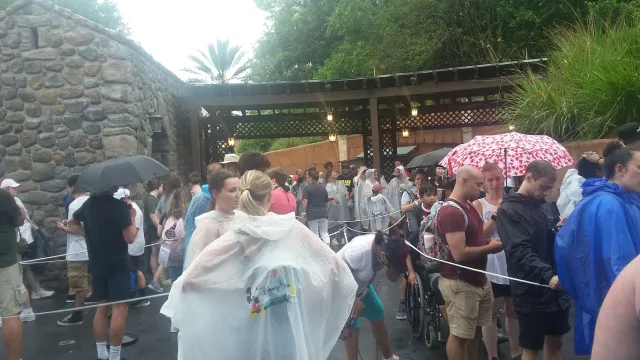
Disney's Hollywood Studios · 1994
Disney California Adventure · 2004
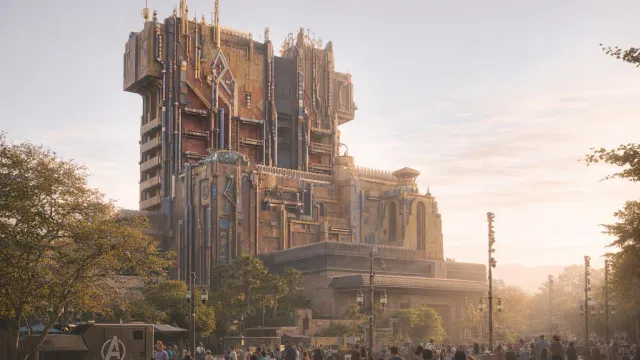
Disney California Adventure · 2017
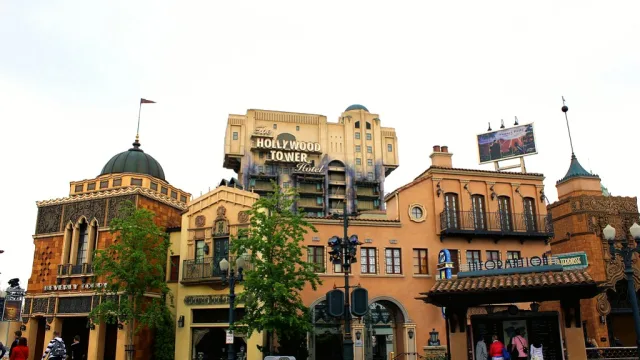
Disney Adventure World · 2007
Eiffel Tower · 1889
Washington Monument · 1888
Empire State Building · 1931
Space Needle · 1962
World Trade Center · 1967
Burj Khalifa · 2010
Lotte World Tower / Seoul Sky · 2017
Willis Tower / Skydeck Chicago · 2018
3 linked attractions