Company profile
KumbaK - The Amusement Engineers occupies a distinctive position in the Dutch amusement industry. The company was founded in 2001 as KumbaK Coasters, shortly after turmoil around Vekoma, by nine former employees of that manufacturer. Its original ambition was to develop completely new attractions, but the company's later development moved strongly toward specialist engineering for existing ride systems. KumbaK therefore became less of a conventional manufacturer with a broad catalogue and more of a technical design and advisory firm for complex, often one-off assignments.
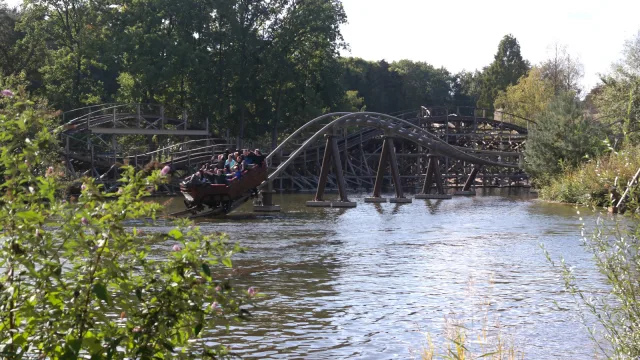
Its best-known own coaster project is De Vliegende Hollander at Efteling. The attraction combines a heavily themed dark ride build-up with a water coaster track and splashdown. Technically it was challenging: the transition from floating boat movement to a steep chain lift, the heavy vehicles, water environment, dark ride scenes and Efteling's high thematic standards made the installation very different from a standard coaster. Opening was ultimately delayed until 2007. De Vliegende Hollander therefore remains both an Efteling icon and a key reference point in KumbaK's story: ambitious, technically instructive and unique within the company's portfolio.
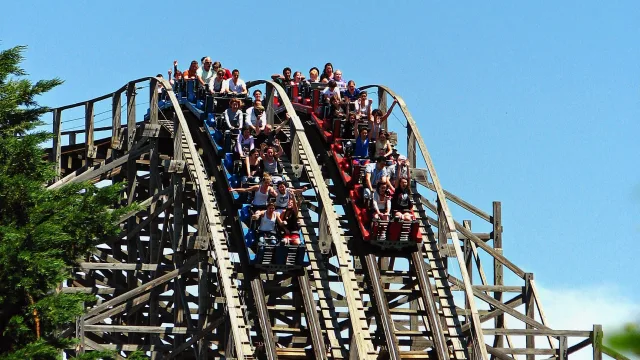
After 2009, KumbaK's public focus shifted clearly toward ride upgrades, replacement parts, safety products and specialized engineering. Its official project history lists work on attractions such as Space Invader 2, Phantom's Revenge, Grand National, Stampida, Tomahawk, Rutschebanen, Arkham Asylum - Shock Therapy, T3, Playland Wooden Coaster and several undisclosed rides. These projects often involve new trains, brake systems, ride controls, evacuation equipment, wheel carriers, show-action equipment or passenger restraint systems.
This makes KumbaK particularly relevant as a life-extension specialist for existing attractions. New coasters attract public attention, but KumbaK often works behind the scenes on modernization, recertification and maintainability. For parks, that work can be just as important: an older attraction can receive new brakes, controls, restraints or components and continue to meet modern safety expectations without losing its historic or thematic identity.
The subtitle The Amusement Engineers fits that evolution. KumbaK presents itself not only as a designer of spectacle, but as a company that makes technical uncertainty manageable. That is especially valuable when the original supplier is no longer active, when components are no longer available or when existing vehicles and controls must be adapted to newer standards. The combination of inspection, engineering, manufacturing support and commissioning makes the company useful in cases where parks cannot simply order an off-the-shelf solution.
KumbaK's role also extends beyond the Dutch market. Its official focus page describes clients on five continents, and project examples range from Canada and the United States to Australia, Denmark, Spain, Austria and the United Kingdom. The company therefore occupies a niche in the international chain of attraction safety, refurbishment and ride lifecycle management.
History
KumbaK was established in 2001 under the name KumbaK Coasters. Secondary coaster sources state that it was founded by nine former Vekoma employees, a background that explains the early concentration of knowledge in steel coasters, vehicles and operational reliability. KumbaK's official history says that the original mission was to provide completely new attractions. Even in the first years, however, the company was already working on technical solutions for existing installations, including an evacuation platform and maintenance device for Great Nor'Easter at Morey's Piers.
In 2003, KumbaK completed a major upgrade of Space Invader 2 at Blackpool Pleasure Beach, involving new vehicles, braking, lift drive, ride controls and track sections. Around the same period, Track Lube Plus was created as a biodegradable lubricant and corrosion protection product that later became a KumbaK product line. The company then worked on projects such as Wereld 3 Stalen Monsters at the Dutch Railway Museum, brake and control systems for Phantom's Revenge and Grand National, and upgrades for Stampida and Tomahawk at PortAventura.
De Vliegende Hollander became the company's most visible own project. Efteling selected KumbaK for the coaster engineering of an ambitious water coaster with a dark ride character. Construction proved difficult and the planned 2006 opening was missed. The attraction eventually opened in 2007 after technical changes, especially around the lift section. The project gave KumbaK international visibility, but also showed the risk of developing a prototype in a heavily themed environment.
In 2009, the company's direction formally changed. KumbaK shifted toward specialized engineering, older coaster upgrades, reverse engineering of replacement parts and safety products. Since then, projects such as Rutschebanen, Sea Viper, Arkham Asylum - Shock Therapy, T3, RoboCoaster seating modules and several Locked-and-Monitored Seatbelt applications have appeared in its portfolio history. The current identity is therefore less that of a serial manufacturer and more that of a specialist in complex technical life extension.
Innovation and technology
KumbaK's technology is centered on analysis, modernization and integration. The company often works on installations where the original manufacturer is no longer available, documentation is incomplete or components have become technically obsolete. In such cases, KumbaK combines inspection, reverse engineering, calculations, production drawings and cooperation with specialized subcontractors. Its official method divides projects into specifications and concept design, design and engineering, manufacturing, installation supervision, testing and commissioning.
In ride upgrades, KumbaK focuses on vehicles, brakes, ride controls, track structures and drive systems. Vehicle work may address fatigue issues, weight reduction, new restraints, containment and improved passenger experience. For brakes, the company replaces or supplements older systems with magnetic eddy-current brakes. Ride control systems are modernized with safety PLCs and HMI interfaces, making faults easier to diagnose and helping older rides comply with current safety expectations.
One important product line is the Locked-and-Monitored Seatbelt system. KumbaK describes single- and double-latch locking units, sensors and controlled retractors. The aim is not only physical locking, but also electrical monitoring, so that a ride cannot dispatch if a belt is not properly locked. KumbaK also supplies reverse-engineered replacement parts, show-action equipment and Track Lube Plus, a biodegradable lubricant and corrosion protection product for wheels, rails, chains and fasteners.
This means the technical work involves more than designing a new component. A modified brake, train or control system has to fit existing loads, foundations, evacuation procedures, inspection documentation and daily operation. KumbaK therefore presents its engineering as a process in which risk analysis, testability and maintenance information are as important as the mechanical design itself.
Industry impact
KumbaK's impact lies less in a large number of new coasters and more in extending the useful life of existing attractions. That is an important but often less visible part of the amusement industry. Older coasters and ride systems may have strong emotional or historical value, while their technology no longer fully meets current expectations for safety, comfort, capacity or maintenance. KumbaK positions itself exactly in that tension.
By modernizing brakes, vehicles, controls, restraints and components, a park can preserve a known attraction without choosing full replacement. Projects such as Rutschebanen, Grand National, Stampida, Phantom's Revenge and the Playland Wooden Coaster show the breadth of that role, from wooden classics to steel coasters and water rides. De Vliegende Hollander made KumbaK visible as a builder of an original coaster concept, but the company's lasting relevance is mainly found in technical continuity, risk reduction and preservation of existing park assets.
That specialization also contributes to sustainability within the sector. When an attraction can be safely modernized, steel structures, vehicles, stations and themed environments do not automatically have to be replaced. KumbaK's value therefore also lies in connecting safety requirements with preservation of existing investments. For parks with heritage attractions, that can become a strategic advantage.
Current operations
KumbaK currently operates from Limburg, with a contact address in Nederweert, and presents itself as a specialist for the worldwide amusement and leisure industry. Its official focus is design, engineering, in-service support and improvement of roller coasters and other ride systems. The company describes clients on five continents and works both for parks and for companies involved in developing or manufacturing new attractions.
The current product and service mix includes ride upgrades, standard safety products, replacement parts, specialized engineering and Track Lube Plus. For manufacturing, KumbaK's stated method uses a network of specialized subcontractors, followed by installation supervision, testing, documentation and training. The company is therefore active primarily as a technical specialist for custom projects, not as a mass producer of standard new attractions.
Because many assignments are custom projects, KumbaK does not always publish client or attraction names. That fits technical suppliers that work behind the scenes for parks, manufacturers and developers. The visible information points to a compact but international organization focused on expertise rather than volume production.
Design philosophy
KumbaK's design philosophy is problem-driven. The company does not begin with a standard model, but with the technical risk, aging issue or operational bottleneck a park needs to solve. Its official method therefore emphasizes information gathering, risk analysis, specifications, concept design and phased decision-making. That fits projects where existing structures, limited space, historical value and modern standards collide.
With De Vliegende Hollander, the philosophy was more ambitious and conceptual: a water ride, dark ride and coaster had to merge into one experience. In later projects, KumbaK became more pragmatic. The emphasis moved toward reliability, maintainability, passenger safety and controlled integration. A successful KumbaK project is therefore not always visible as a new attraction, but it is felt in smoother braking, modern controls, safer restraints and longer service life.
That approach requires restraint. KumbaK does not always need to reinvent an attraction; often the best solution is an improvement that remains invisible to guests but is clearly felt by maintenance teams and operators. Design quality then lies in reliability, documentation and predictable behavior under daily operating loads.