Company profile
Garmendale Engineering Limited is a British manufacturer and specialist engineering company with a distinctive role in the European attractions industry. It is not a mega-supplier of record-breaking roller coasters, but a practical designer, builder and service partner for ride systems that need to be safe, compact, maintainable and highly adaptable to theming. Garmendale was founded in Derbyshire in 1980 by Roy Shelmerdine. Its operational base is Dale Works on Manners Industrial Estate in Ilkeston, while Companies House records Garmendale Engineering Limited as an active private limited company incorporated on 18 January 1989.
The company’s first decades were shaped by specialist metalwork, rail-like projects, refurbishments and problem-solving engineering for customers that needed bespoke solutions. According to its own origin story, a major turning point came in 1991 when Garmendale was asked to survey and refurbish a ride at American Adventure. It then moved into train and track-system projects in several countries, engineering support for London Eye capsules and a growing relationship with Merlin Entertainments. That background explains why Garmendale is both manufacturer and engineering service provider today: it supplies complete systems, but also parts, safety solutions, refurbishments and installation support.
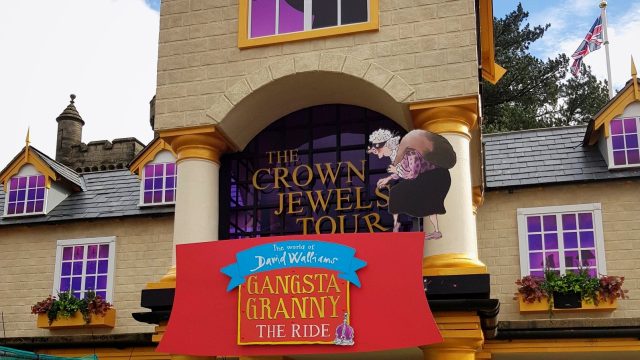
In W8baan, Garmendale is most visible through three active British family rides. Jungle Rangers at Chessington World of Adventures is a track ride in the Rainforest area. Gangsta Granny: The Ride at Alton Towers uses Garmendale’s Spin Master dark-ride system and combines rotation, show sets, projection, sound, scent and special effects around David Walliams’ story. Go Jetters Vroomster Zoom Ride is a QuadStar aerial roundabout in CBeebies Land, designed and manufactured in the UK factory with vehicles that young guests can control. Together, these installations show Garmendale’s core territory: accessible family rides integrated with IP, theming, safety and consistent capacity.
The manufacturer also developed product lines such as Spin Master, TrackMaster, MotionMaster, MotionMaster30, Mag Master, QuadStar and Automated People Mover systems. Its RG-11 Shotgun gating concept became an important safety product, with the first installation on Colossus at Thorpe Park in 2002. Garmendale combines mechanical build, steel fabrication, GRP vehicle finishing, show integration and maintenance. The company’s value therefore lies not only in new rides, but also in longevity: making systems understandable for operators, adapting vehicles to new themes, improving safety on existing attractions and extending operational reliability.
What matters is that Garmendale approaches many projects from the question of how an attraction will be operated, inspected and adapted every day. The company did not build its brand around extreme speed or height, but around technical dependability in environments where children, families and operators interact closely. That practical attitude is visible in modular product families, emphasis on containment and boarding safety, and the ability to adapt vehicles and GRP forms to different IPs. For international parks, it means a supplier that understands both new construction and aftercare.
History
Garmendale began in 1980 when Roy Shelmerdine founded an engineering company in Derbyshire to solve difficult metalwork and construction problems. Early projects sat outside the classic theme park world: water installations, rail-related work, specialist fabrication and bespoke industrial tasks. The formal company Garmendale Engineering Limited was incorporated on 18 January 1989 according to Companies House. In 1991 the step toward leisure engineering arrived when the team was asked to survey and refurbish a headline attraction at American Adventure.
During the 1990s, Garmendale worked on train and track-system projects and gained experience in locations including France, Japan, Brunei, Greece and Singapore. One notable prestige project was a quarter-scale Bessemer converter model for a museum in Japan, built using traditional techniques under Roy Shelmerdine’s supervision. Around 2000 the relationship with major leisure operators deepened. Garmendale supported the London Eye with capsule refurbishment, mechanical door-latch work, platforms and maintenance projects.
In the 2000s, David Shelmerdine, Roy’s son, took a greater leadership role. That period brought the RG-11 Shotgun gates, with Colossus at Thorpe Park as the first installation in 2002. More Merlin projects, Snowdon Mountain Railway work and international safety solutions followed. From the 2010s onward, Garmendale developed its own ride systems such as QuadStar and Spin Master. Go Jetters Vroomster Zoom Ride, Gangsta Granny: The Ride and Jungle Rangers show how the company evolved into a manufacturer of compact, IP-ready family attractions alongside refurbishment and service work.
The history also shows a consistent family line. Roy Shelmerdine laid the foundation with craft engineering and difficult fabrication work; David Shelmerdine moved the company deeper into the attractions and inspection world and became active within NAFLIC, a UK organisation connected with amusement ride inspection and safety. The company’s own blog repeatedly presents safety, reliability and solving “impossible” problems as recurring themes. Garmendale can therefore not be understood only through its product catalogue, but also through a culture of practical craftsmanship. The move into proprietary ride systems was not a break with the past, but an application of the same metalwork, rail and maintenance knowledge to family-friendly attractions.
Innovation and technology
Garmendale’s technology is based on practical systems integration. The manufacturer combines steel fabrication, mechanical drive, control systems, safety, GRP finishing, vehicle design and themed interfaces. On family rides such as QuadStar, the priorities are reliable repeat motion, low access thresholds, passenger control, full containment and a compact footprint. The company’s QuadStar blog describes driver yaw control, a height of around 4 metres and a stabilising rod system inside the arms to keep the gondolas smooth and level.
For dark rides, Garmendale uses systems such as Spin Master, TrackMaster and MotionMaster. Spin Master offers programmable rotation, controlled stops and vehicles for several capacity formats, allowing a story to be told through sets, effects and media. Gangsta Granny: The Ride is a visible example: a guided dark ride with projection mapping, animation, audio, scent and special effects built around a compact vehicle system. The technical challenge there is not only motion, but timing and maintainability.
A second pillar is safety and throughput. The RG-11 Shotgun gating system is designed for controlled boarding, exit gates, high reliability and integration with ride controls. Garmendale also provides refurbishments, platforms, transport and installation solutions. The company stands out through technical fit: adapting existing attractions without losing their operational identity.
The technical architecture is deliberately conservative where necessary and flexible where it adds value. For young guests, predictability matters: clear restraints, controlled speeds, visible operator procedures and simple evacuation. For parks, the back of house is just as important: access to drives, cables, sensors, hydraulics or pneumatics, replaceable parts and documentation for inspectors. Garmendale’s platforms try to connect those two worlds. The same base can become a jungle jeep, Vroomster, book character or fully custom vehicle, while the maintenance team keeps a recognisable mechanical package.
The Shotgun gates show the same approach at station level. They do not create show value by themselves, but make dispatch more predictable and reduce operational risk. In refurbishments, Garmendale adapts existing steel or vehicle structures without always requiring full replacement.
Industry impact
Garmendale’s impact is less about world records and more about the quiet foundation on which many modern family attractions operate. The company represents a type of manufacturer that is especially valuable to parks: close to the operator, technically flexible, willing to customise and strongly focused on safety and aftercare. In a market where IP attractions often have to be fitted quickly into existing buildings or areas, that combination matters more than spectacular statistics.
With the RG-11 Shotgun gates, Garmendale contributed to dispatch, boarding control and operational safety. With QuadStar, Spin Master and TrackMaster, it shows that compact rides can be adapted to themes without designing a completely new mechanical platform every time. The Merlin projects at Alton Towers, Chessington and Thorpe Park show how a regional British engineering firm can influence major park portfolios. Its refurbishment work also keeps existing attractions useful for longer, supporting cost control, sustainability and heritage value.
Garmendale’s industrial impact also lies in the professionalisation of small and medium-sized rides. While large media dark rides are often built by international consortia, Garmendale shows that regional engineers can apply a similar discipline to compact systems. The company helps parks give children’s areas, IP zones and existing attractions a technical foundation that not only looks attractive, but remains inspectable and repairable. For Merlin and other operators, that means short communication lines, local craftsmanship and a supplier that understands both creative demands and ADIPS/NAFLIC-style safety expectations.
By combining its own platforms with custom vehicles, Garmendale strengthens a broader trend: rides increasingly become reusable technical carriers for changing stories. That makes retheming, expansion and lifecycle planning easier.
Current operations
Garmendale Engineering remains active as a family-run company operating from Dale Works in Ilkeston, Derbyshire. Its official website presents ride systems, Shotgun gating, Gel Tec GRP and services including specialist engineering, park maintenance, installation services, ride refurbishments, zoo engineering and FRP/GRP systems. Companies House lists the company as active, with a registered office in Derby and SIC code 42990 for civil engineering projects.
Its current market position is that of a flexible British supplier for operators seeking compact attractions, safety systems or refurbishment work. Garmendale is visibly active for Merlin parks, but also presents itself internationally through IAAPA and its own product lines. Blog activity in 2025 and 2026 shows that the company continues to communicate its history, product families and available installations actively.
Garmendale also continues to invest visibly in communicating its heritage and product development. The 2025 origin story series presents the company strongly as a second-generation family business with a long relationship with Merlin, the London Eye and international technical projects. Product pages for dark rides, QuadStar, RG-11 and GRP services show that the portfolio remains broad: from new ride system to station gate, vehicle body, themed finish and maintenance intervention.
Operationally, that profile is valuable because parks often do not need a completely new attraction, but a dependable technical partner for a specific problem. Garmendale can then act as manufacturer, installer, maintenance partner or refurbishment specialist.
Design philosophy
Garmendale’s design philosophy is pragmatic: safety and maintainability first, then thematic flexibility. The company builds systems that operators can understand, technicians can maintain and creative teams can dress for an IP or story. Platforms such as QuadStar and Spin Master are therefore not tied to one visual form. The underlying mechanics can remain the same while vehicles, audio, projection, scenery and GRP shapes change.
A second principle is longevity. Garmendale communicates strongly around reliability, quality and aftercare, and its own history shows that refurbishment and problem-solving are as important as new construction. That philosophy suits family attractions where daily availability, simple evacuation, safe boarding and recognisable theming have to come together.
In design choices, this means the guest does not always notice how much technology sits behind the experience. On Gangsta Granny, the family should mainly experience a comic heist; on Go Jetters, young children should feel their Vroomster respond; on Jungle Rangers, the vehicle should be simple enough to suggest control without exposing operational complexity. Garmendale therefore designs the machine as a carrier of trust. The ride does not need to be the largest in the park, but it must work safely, understandably and thematically every day.
That philosophy fits a changing market in which parks regularly adapt IP areas. A robust base platform with a replaceable thematic layer gives operators more freedom than a completely fixed attraction.