Company profile
Bradley & Kaye Amusement Co. occupies a distinctive place in amusement industry history. It was not a large global ride group, but a focused American specialist that helped define the postwar children’s ride market. The company grew out of Beverly Park, the small but influential kiddieland at Beverly Boulevard and La Cienega Boulevard in Los Angeles. David Bradley bought the park in 1945 with Donald Kaye and developed it not only as an operating park, but also as a practical showroom for ride ideas. Beverly Park demonstrated how compact attractions, clean presentation and a child-centred sense of independence could become a strong family proposition.
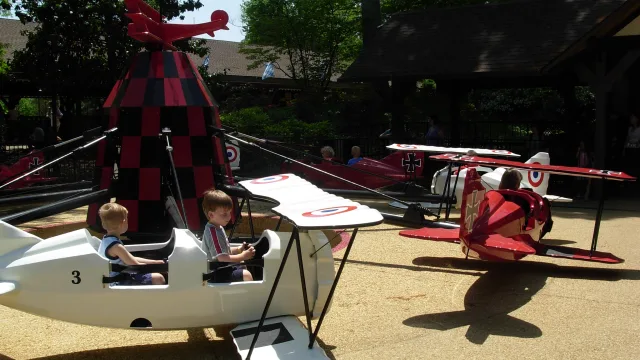
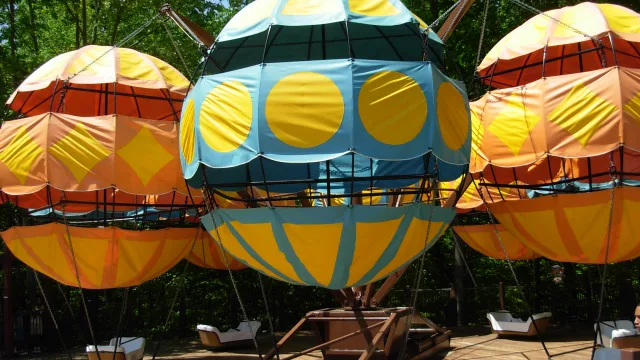
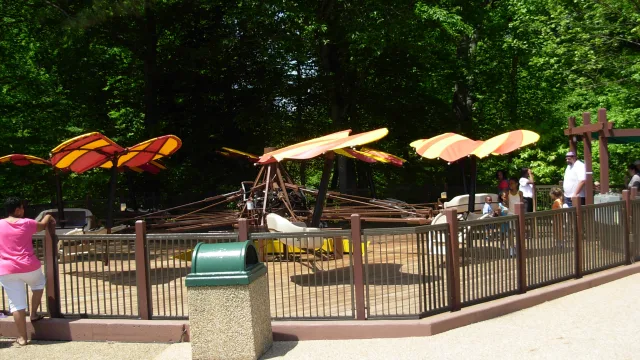
The company later became associated with Long Beach, California, where Bradley & Kaye manufactured children’s attractions and ride components. Its earliest widely documented product line was the Little Dipper, a portable steel kiddie coaster with a simple oval layout. After the first Bradley & Kaye examples, the design was distributed more broadly through Allan Herschell, giving the model a long life in American family parks. During the 1970s and 1980s, the company added a wider catalogue of recognizable rides, including Red Baron, Balloon Race, Hang Gliders, Barnstormer, Antique Autos, junior track rides, dark ride pieces, boat rides and selected custom projects.
Bradley & Kaye worked mainly in the part of the market where reliability, scale and character mattered more than records. Its rides were built for children and families, with small footprints, readable movements, approachable themes and straightforward operating patterns. That explains why installations connected with Busch Gardens Tampa, Busch Gardens Williamsburg, Hersheypark, Lagoon, Calaway Park and Canada’s Wonderland continue to appear in park histories and ride databases.
A second legacy lies in carousel work. David Bradley reproduced and reinterpreted classic carousel animals in fiberglass, paying close attention to decorative forms associated with historic carving traditions. When Chance Rides acquired Bradley & Kaye’s assets in December 1986, those moulds and figure rights were a central part of the value transferred. The name therefore survived the company itself through Chance carousels, where Bradley & Kaye horses and wildlife figures continued to be identified as part of the product language.
Bradley & Kaye is best understood as a bridge between park operation, small-scale engineering and themed craft. Its family rides were not meant to dominate a skyline. They were designed to be legible, friendly and durable, giving young visitors a first feeling of motion, control and adventure while giving operators compact equipment that could be maintained over long periods.
History
The history of Bradley & Kaye begins in 1945, when David Bradley and Donald Kaye acquired Beverly Park in Los Angeles. The site was small, but it gave Bradley exactly the environment he needed: a place where children could ride safely and where new ideas could be tested in front of real guests. Kaye left the business early to return to the music industry, but Bradley kept the company name. Beverly Park therefore remained both a family destination and a practical demonstration ground for the manufacturer.
From 1947, Bradley & Kaye developed the Little Dipper, a portable kiddie coaster that was later distributed more widely through Allan Herschell. The design matched the postwar demand for compact, affordable children’s attractions for parks, carnivals and recreation operators. Beverly Park also became known as an influence on Walt Disney, who visited Bradley and later used him as a consultant while Disneyland was being developed. That connection gives Bradley & Kaye a wider historical relevance, even though the company itself remained comparatively small.
During the 1970s, production became more professional around Long Beach. Red Baron appeared as an airplane-themed ride, followed by Balloon Race, Hang Gliders, Barnstormer and several custom attractions. RCDB notes that Bradley & Kaye advertised mainly coaster cars in 1972 and was advertising complete children’s coasters by 1984, with James C. Palmer listed as president. The company therefore moved between components, complete rides and decorative specialties.
The final phase was strongly connected with carousel figures. Bradley had studied older carousel traditions and produced fiberglass reproductions with a historic character. In December 1986, Chance Rides purchased Bradley & Kaye’s assets. That ended the company as an independent manufacturer, but its moulds, figure rights and style remained visible in Chance carousel production. Because public company archives are limited, many dates come from later park records and ride databases. The chronology should therefore be read carefully: the main line is clear, but details about individual orders, serial numbers and internal organization remain fragmentary. That caution is appropriate for a defunct manufacturer whose surviving rides are often easier to trace than its business papers.
Innovation and technology
Bradley & Kaye’s technology centred on compact mechanics for young audiences. The Little Dipper is the clearest example: a small steel kiddie coaster with a chain lift, oval layout and train configuration suited to limited footprints and modest speeds. The design gave children the sensation of a real roller coaster without the scale, forces or operating complexity of larger thrill rides.
For Red Baron, Hang Gliders and Balloon Race, Bradley & Kaye used legible movements: rotation, gentle lifting, controlled lowering and a theme that made the mechanical action easy to understand. The airplane and balloon bodies were not merely decoration; they helped young riders read the ride experience before boarding. For operators, these rides offered relatively simple foundations, limited cycle capacity and maintenance patterns closer to traditional flat rides than to complex ride systems.
Another technical specialty was fiberglass and mould making. Bradley developed carousel animals that evoked historic wooden carving while being reproducible in modern material. That approach allowed consistent figures for new carousels, while preserving a visual language associated with older American carousel culture. The fact that the moulds remained valuable to Chance Rides after 1986 shows that the company left behind not only ride systems, but also transferable design and production assets.
Bradley & Kaye was therefore a pragmatic technical builder rather than a record seeker. Its strengths were simplicity, child-appropriate motion, readable themes, durable fabrication and equipment that could remain useful to operators for decades. The technical value therefore lay in repeatability. A park could order a recognizable theme, place the ride in a children’s area and rely on a motion profile that was predictable for attendants and parents. When units were relocated or refurbished, the mechanical logic remained understandable, which helps explain why many examples remained documented or operating long after the company disappeared.
Industry impact
Bradley & Kaye’s impact lies mainly in the family segment of the amusement industry. The company showed that children’s rides did not have to be merely smaller versions of adult rides; they could be dedicated products with recognizable themes, gentle movement and polished presentation. The Little Dipper helped spread the idea of the steel kiddie coaster, while Beverly Park functioned as a test site and showroom proving that such attractions could work commercially and emotionally.
The connection with Walt Disney adds historical significance. Bradley’s emphasis on cleanliness, safety, comfort and the child’s point of view aligned with broader ideas that later appeared in Disneyland. Bradley & Kaye was not a Disney design office, but it was a relevant source of inspiration within the development of child-friendly park experiences.
The physical legacy also continued through Chance Rides. The carousel figures and moulds transferred in the 1986 acquisition gave Chance carousels a decorative line rooted in Bradley’s interpretation of classic animals. Surviving and documented Red Baron, Balloon Race and Hang Glider installations show that the company built durable, relocatable and recognizable family rides with long operating lives. For contemporary parks, that influence is most visible in children’s areas where older installations continue to operate beside newer IP-driven attractions. Bradley & Kaye shows that the longevity of a family ride depends not only on brand value, but also on mechanical simplicity and emotional legibility.
Current operations
Bradley & Kaye no longer operates as an independent manufacturer. Its assets were sold to Chance Rides in December 1986, and no current official Bradley & Kaye website, product catalogue or sales organization has been found. Today, the name appears mainly in historical databases, park archives, coaster and ride wikis, and documentation connected with Chance carousels.
The practical legacy has two parts. First, several Bradley & Kaye attractions still operate or remain documented in parks, including Red Baron, Balloon Race and Hang Glider installations. Their day-to-day maintenance is handled by park operators and specialist service providers. Second, Bradley’s carousel figure work lives on in Chance Rides products, where Bradley & Kaye horses and wildlife figures continue to appear in specifications and brochure material. New Bradley & Kaye rides are not produced, but the historical design work remains visible in surviving installations. For documentation, “current operations” should therefore be read mainly as heritage status. The relevant questions are not production capacity or order book, but which installations still run, which components have survived through operators and how Chance Rides integrated the decorative legacy.
Design philosophy
Bradley & Kaye’s design philosophy grew out of Beverly Park: children should feel safe, seen and independent. A ride had to be understandable before it started, attractive to parents and still adventurous enough to be memorable. The company therefore combined small scale with clear themes such as airplanes, balloons, cars and trains.
Bradley’s approach was also highly operational. A ride had to fit a limited footprint, run reliably and look carefully presented. Instead of pursuing speed or height, Bradley & Kaye focused on recognizable motion and decorative quality. In carousel work, that philosophy extended into historical craft: classic animals were not simply copied, but translated into reproducible fiberglass figures with nostalgic presence. This combination of pragmatism and charm explains why many designs remained useful for decades. The company’s strongest designs were therefore intuitive. Children recognized the vehicle, parents recognized the safe scale and operators recognized equipment that required little explanation. That triangle of imagination, trust and operating ease defines the Bradley & Kaye profile.